It's a program you install on your own computer. You talk to it the way you'd talk to a person: how much you want to invest, how much you're willing to lose, and over what period. It builds strategies and tests each one with AI research tools, the way a fund would. It only starts trading in your brokerage account after you authorise it.
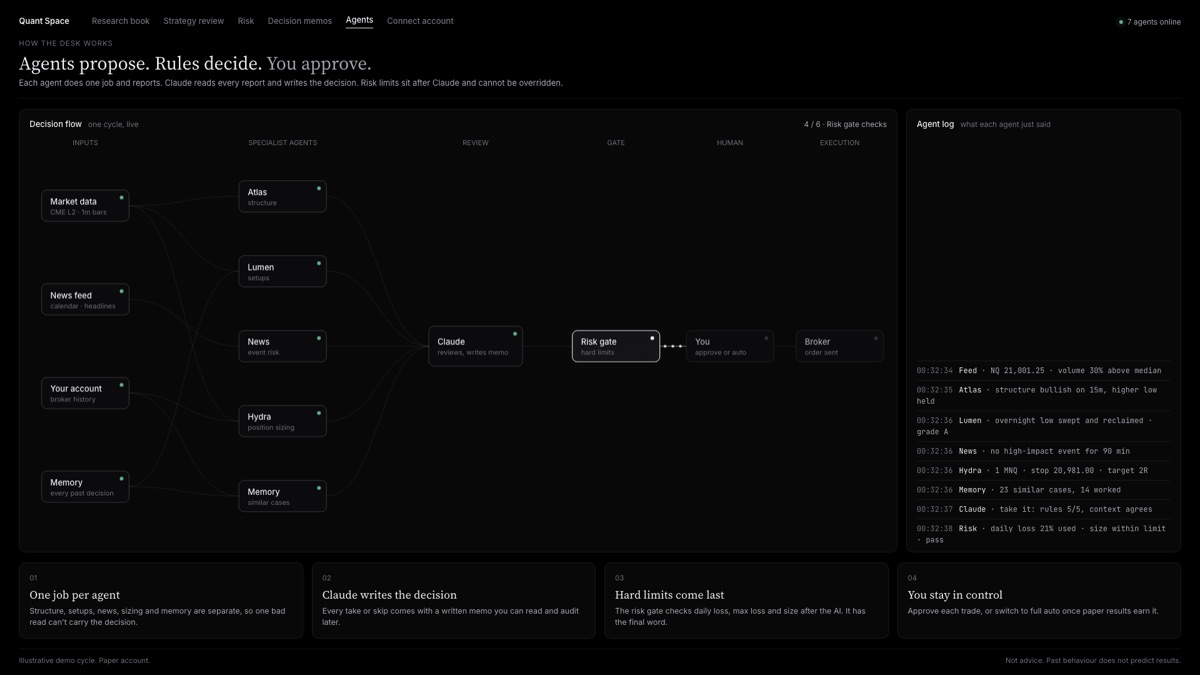
A real desk has an analyst, a researcher, a bull, a bear, a risk manager, a trader and a decider. Here each seat is an agent, working inside the limits you wrote, enforced in code.
I build it on your rules, test it and set it up for you. You just run it.
The desk method in your hands. Seven AI agents and a 15-minute routine. You build it, no code.
Claude
Hermes (Nous)
ChatGPT
Grok
OpenClaw</>code (risk gate)Say how much you want to put in, how much you'll accept losing, over what period, and how you like to trade. Free text. Every conversation is saved, so the desk remembers what you decided and why.
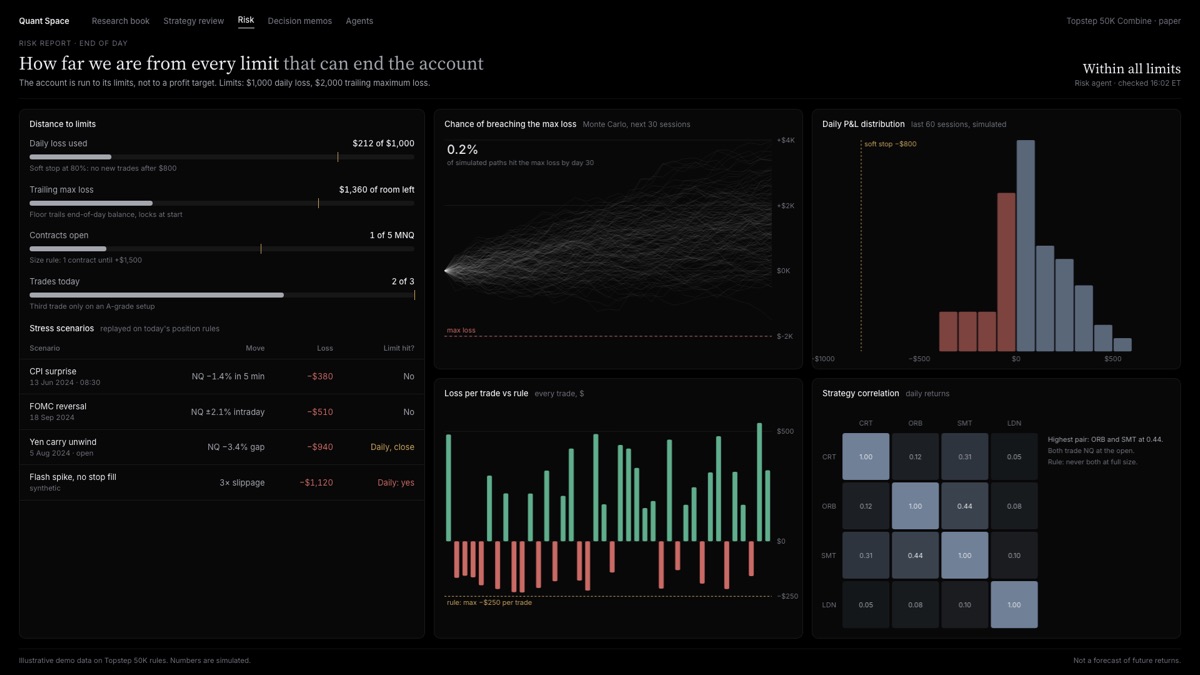
Limits are enforced in code. Agents can tighten them, never loosen them.
YOU</>

LAB

</>

$dashed = code, not AI · agents can't skip a step
Every variation is tested on data it never saw, stressed with thousands of reshuffled runs, and charged higher costs than your broker's. You only see what survives, with the full test behind it.
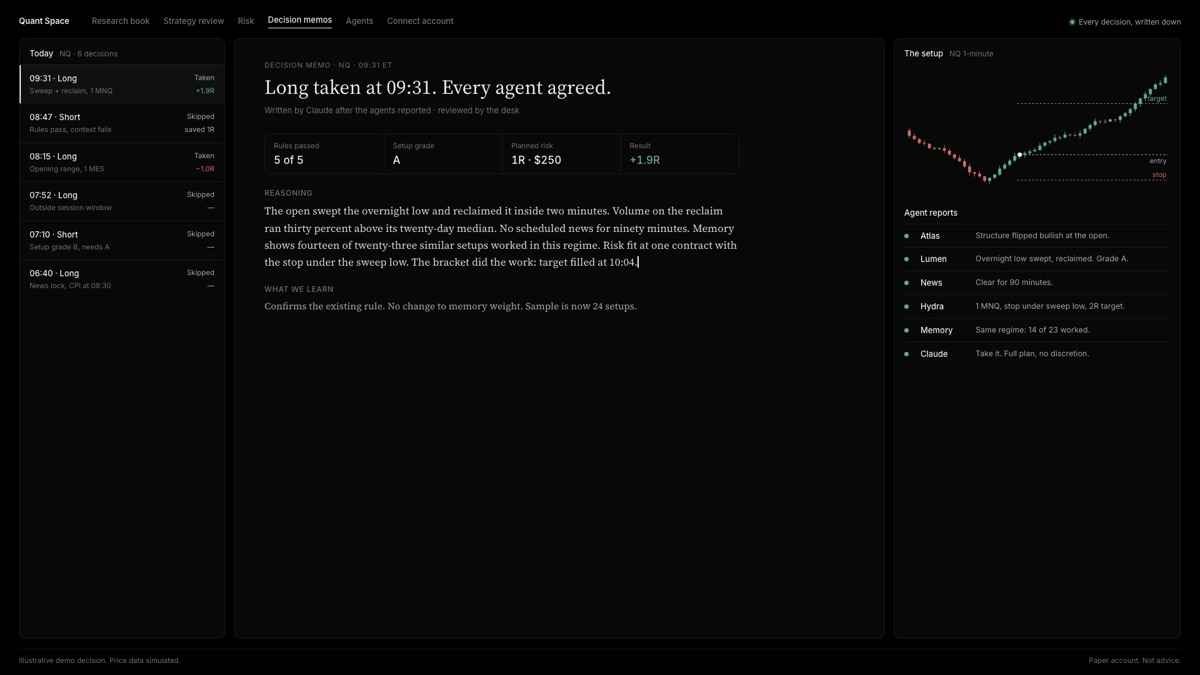
Every idea that survives the lab ends in a written memo: what was tested, what failed, what the bull and bear said, and the worst run against your limit.
| Held-out data (walk-forward) | PASS |
| Small change to the rules | stable |
| Costs 1.5× your broker's | still positive |
| Overfit probability (PBO) | 0.18 |
| Trades in the test | 212 |
| Other versions tested | 11 rejected |
Bull· ChatGPT
Bear· GrokYou keep your account at your own broker, exactly as today. Quant Space never receives, holds or withdraws money. It only sends the orders you authorised and reports back what it did.
On a professional desk each of these has an owner and a method. On yours, they all land on you, usually at the same moment.
The move happens while you're at work or asleep. You see it later, already over.
You can read a chart. Measuring whether it's a pattern or a coincidence is a different skill.
A strategy that lives in your head can't be tested, repeated or checked after it fails.
Nobody sizes a trade well after two losses in a row. It isn't a character flaw, it's biology.
A good-looking backtest proves nothing. Proof is surviving data it never saw.
In plain words: how much to put in, how much you accept losing, and over what period.
Rules get written and tested. A bull and a bear debate the results. Risk can add a veto, never lift one.
A written decision with the tests behind it: discard, research further, or paper candidate.
Paper first. Only after you authorise it does it connect to your broker and trade inside your limits. Going live is always your call.
In your own account, at your own broker. Quant Space never receives, holds or withdraws money. It sends orders you authorised and reports back.
No. Loss limits live in code and are checked twice. Agents can add a veto, never remove one, and nothing goes live without your authorisation.
A slice of history is held back. If the idea only works on the part it was built on, it memorised, and it's rejected.
Nudge its numbers. If the result falls off a cliff, it was luck, not an edge.
Thousands of reshuffled paths show the drawdown to expect before you risk anything.
Your loss limits are checked in code, twice. No agent can argue its way past them.


Build a desk that thinks in rules, argues with itself, and asks you before it acts.
I build it on your rules, test it and set it up for you. You just run it.
The desk method in your hands. Seven AI agents and a 15-minute routine. You build it, no code.
No promise of returns.
Quant Space is research and decision-support software. It does not manage money, give financial advice or promise any result. Nothing trades without your explicit authorisation, everything starts on paper, and your money stays in your own brokerage account. Trading involves substantial risk of loss.
@theprinceofagents